

Every SaaS product asks you to trade something for convenience. Usually that trade is fair. You give up a little control, you get back a lot of time.
SFTP-as-a-service asks for something different. It asks for your files, or the keys to get to them itself.
The trade nobody names out loud
Sign up for almost any managed SFTP or SFTP-as-a-service product and the pitch sounds the same: stop running your own server, stop patching, stop worrying about uptime. Let us handle it. Fair enough. Running SFTP infrastructure yourself is genuinely tedious (and often complicated) work, and offloading it is a real win.
But “let us handle it” almost always expands into “let us handle your files too.” Somewhere between signing up and your first transfer, one of two things happens:
Your files land on the vendor’s cloud, sometimes briefly, sometimes permanently.
Or, increasingly common, the vendor connects directly to your own S3, GCS, or Azure Blob storage, which means you hand over the credentials to do it: access keys, IAM roles, service accounts. The files never move, but the vendor now holds a set of keys that can reach in and take them whenever it wants.
Neither of those is optional in most SaaS SFTP products today. It’s their architecture, full stop. And the second pattern is easy to overlook, because nothing about it feels like “giving up your files.” It just feels like configuring a connection. The access is the same either way.
Why this became “normal”
It became normal for a boring, understandable reason: it’s the easiest way to build the product. If the vendor’s cloud is a waypoint your files pass through, or if the vendor has standing access to your bucket, the engineering is straightforward. Most of the category was built this way because most of the category needed to ship fast.
That doesn’t make it a requirement. It makes it a default that stuck around long enough to look like one.
The question worth asking
If the entire value of “as-a-service” is convenience, and the entire cost is access to your data, the real question isn’t “is this convenient.” Of course it is. The question is: does the convenience actually require the access?
Put another way: could a service manage the server, handle the protocol, take care of authentication and monitoring and all the operational weight, without ever needing to see, hold, or reach directly into your files?
We think the answer is yes. That’s the premise we’ve been building SFTP.cloud around: all of the “as-a-service” convenience, none of the “give us access to your data” part of the deal. And this diagram shows you how we did it.
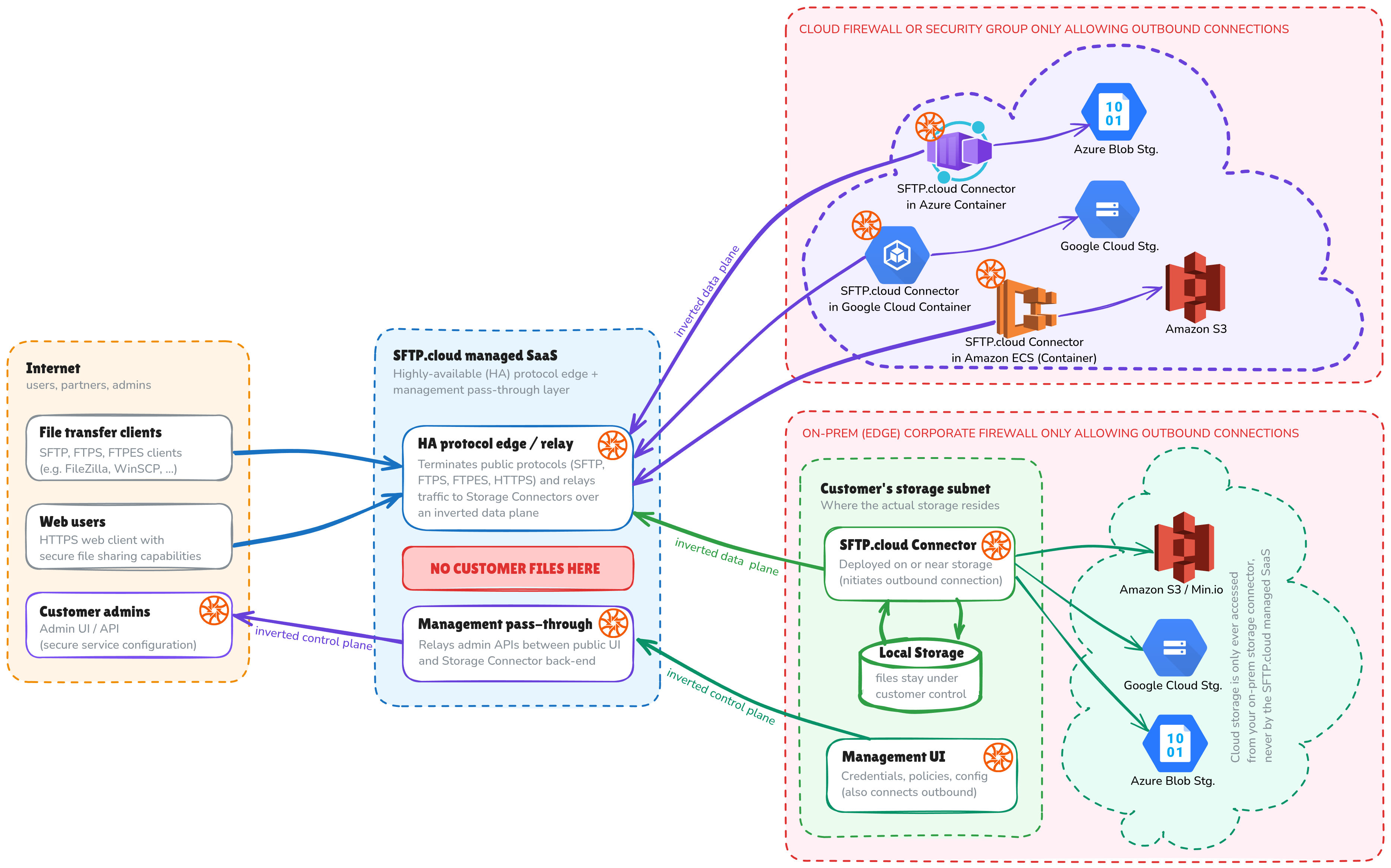
Surprise! The compromise most of this category treats as inevitable turns out to be a choice, not a constraint.
What to watch for
If you’re currently comparing SFTP-as-a-service options, a compromise-free product should be identifiable by what it doesn’t ask you for:
It shouldn’t need standing access into your storage, and it shouldn’t need your credentials to get it.
It shouldn’t need your files to be cached or sit on its infrastructure at any point, ever.
It shouldn’t care whether your storage is in the cloud or sitting in your own data center.
If a vendor can’t say yes to all three, you haven’t found the compromise-free version. You’ve found the default one.
We’re building SFTP.cloud to be the SFTP-SaaS that doesn’t ask for the trade. Early access is open to the first 100 people who want in: reserve your spot at SFTP.cloud. Not ready to commit yet? Subscribe to this blog and we’ll keep you posted.