

In a previous post we showed a secure ingestion pipeline built with Syncplify Server! v7 and R2FS!, where files are staged locally, scanned, and only then written to backend storage through a reverse connection.
That design keeps the storage subnet completely private (no inbound firewall rules, no NAT, no mounted shares) but it also raises an obvious question:
How much performance do you lose?
To find out, we ran a quick stress test using our internal multi-protocol testing tool called Grinder.
Same server, same network, same client, same settings; The only difference was the storage target.
On the left, files are written to the Syncplify Server!’s local disk.
On the right, the same workload is written to a NAS located in a private subnet, reached through R2FS!.
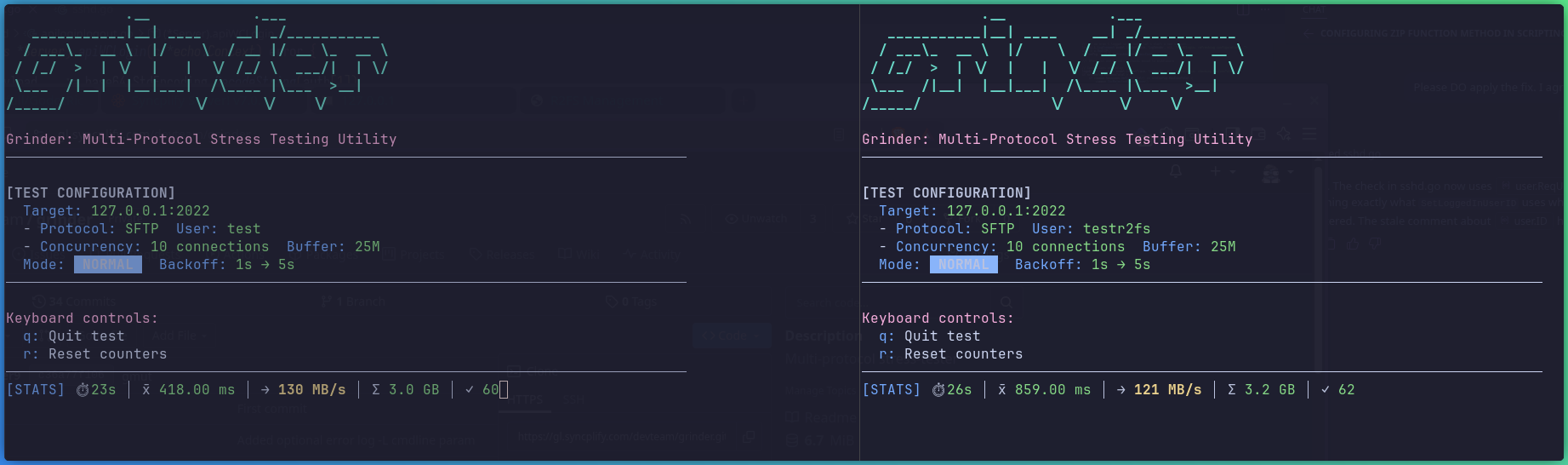
The local disk test reached about 130 MB/s.
Through R2FS!, with two extra network hops, encryption, and a reverse tunnel, the transfer rate was still around 120 MB/s. That’s only a 7.7% performance penalty!
That’s the key takeaway.
When adding R2FS! into the mix, the performance impact is surprisingly small! Small enough, in fact, that in most real-life deployments the added isolation (security) is easily worth it.
Remember that in this setup the storage system never accepts inbound connections at all. The R2FS! agent connects outbound to Syncplify Server!, which means the backend can stay behind a strict firewall while still being exposed as a VFS on the server.
You get segmentation, scanning, and controlled access, without turning your storage network into part of the DMZ. And all this without sacrificing performance.
For completeness: yes, the stress tool shown in the screenshot is ours.
We built Grinder in-house to test Syncplify Server! and R2FS! under high concurrency across SFTP, HTTPS, and FTP/FTPS, and it’s what we use internally to validate designs like this.
R2FS! was designed to improve security, not speed, but it’s nice to see that you don’t have to give up much performance to get it.